Rewriting the Performance Curve
for Digital SoC Simulation
Up to x100 faster verification from architecture to tape-out.
Hiveware is a next-generation SystemVerilog simulator built from the ground up to remove verification from the critical path of modern SoC development.
Rewriting the Performance Curve
for Digital SoC Simulation
Up to x100 faster verification from architecture to tape-out.
Hiveware is a next-generation SystemVerilog simulator built from the ground up to remove verification from the critical path of modern SoC development.
Lightning fast verification.
From Architecture to Tapeout.
x10-x100
Faster full-chip and cluster-level simulation (roadmap trajectory)
15× more
Debug iterations per engineer,
per day
80%
80% Machine utilization for
existing infrastructure
Designed to scale verification throughput without expanding headcount or emulation spend.
Designed to scale verification throughput without
expanding headcount or emulation spend.
Verification performance needs
to be much faster
Hidden bottlenecks stretch debug cycles, delay tape-out, and increase risk.
Pre-Tapeout Bottlenecks
Cluster level and Full-chip simulations that are on critical path to tapeout stall progress when runtimes stretch into days or weeks.
Limited Debug Throughput
Slower debug as engineers spend office hours context switching between debug tasks, waiting for slow re-run results instead of fast turn around time for re-runs to allow focused debug.
Emulation Dependency
Full chip workloads get pushed to expensive, capacity-limited emulation hardware.
Underutilized Compute
Verification tasks often run at ~40% CPUs utilization, wasting paid-for compute.
Software simulation that wins work back from emulation
As SoCs grow larger and more complex, traditional simulators hit a wall. Teams compensate by pushing more workloads onto emulation.
They trade speed for cost, capacity limits, and slower debug cycles.
Hiveware is built to close exactly this gap. By rethinking simulation architecture from first principles, we enable software simulation to reclaim workloads that would otherwise be forced into emulation.
An Industry That Stopped Moving
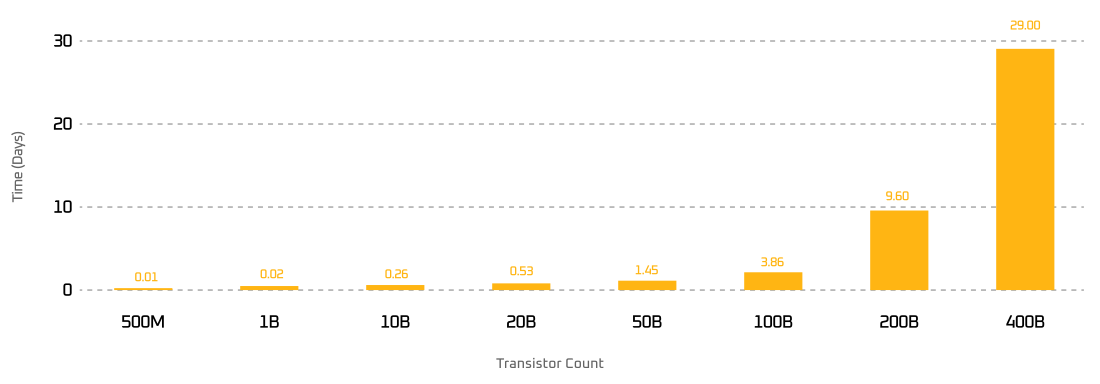
For more than three decades, digital simulation performance has barely advanced, while SoC complexity exploded.
Verification Run Time (Days) vs. Gate Count
(*) Technologies as Multithread or GPU can cut this time linearly
Simulation didn’t keep up. Verification became the bottleneck.
Chip designs grew from millions to hundreds of billions of gates.
But simulation performance plateaued. As runtimes stretched from hours to weeks, verification quietly moved onto the critical path to tapeout, constraining teams long before silicon ever reached the fab.
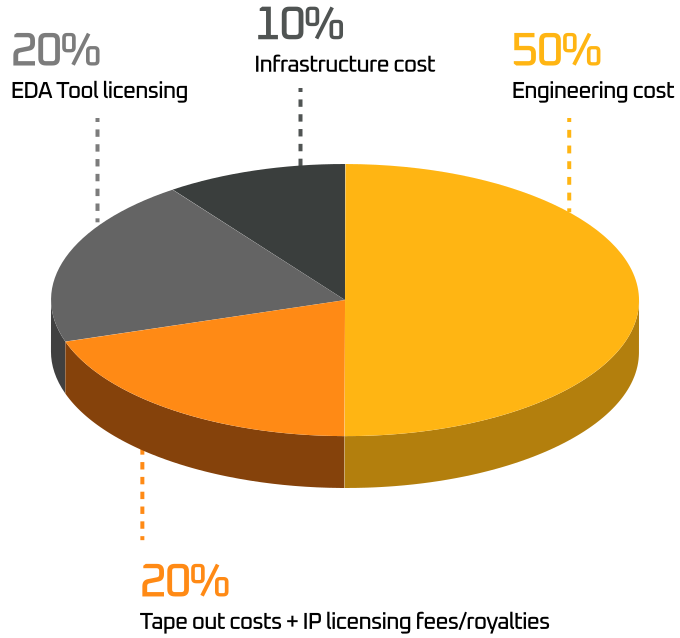
Chip design project cost breakdown
Do More With What You Have: The Hiveware Advantage
Engineering, compute, and EDA licenses drive ~80% of chip project expenses. Hiveware maximizes your existing footprint to deliver more debug cycles per day, better utlize compute CPU and memery and significantly reduce reliance on costly emulation. Pull in your schedules and hit tape-out faster or cleaner using the resources you already have.
Shift left
Instead of layering performance on top of legacy assumptions, Hiveware rethinks simulation from the ground up to reduce turnaround time, increase iteration during working hours, and make large-scale verification more predictable. Faster-than-ever verification runs pull debug back into the working schedule.
More debug loops in a single day
SystemVerilog engine for SoC-scale RTL
Built for full-chip and cluster-level verification environments.
High-throughput RTL regression on standard servers
No specialized hardware such as GPU or emulation is required to achieve performance gains. Additional acceleration is possible with GPUs, but they are not required.
Waveform-ready runs without no runtime penalty
Generate waveforms as part of regular debug flows, shortening the path from failure to insight.
Multi-threaded, multi-host SystemVerilog
Native parallelism across CPUs and hosts, designed to scale on modern infrastructure, on-prem or in cloud-based environments.
Cloud Friendly
Hiveware can run on-premises on local machines, and also supports deployment on your preferred cloud platform.
Move selected SoC workloads off emulation
Rebalance verification cost, capacity, and speed.
Software simulation,
re-architected for modern SoCs
Traditional simulators underutilize machines and engineering time. HiveSim shifts verification left, enabling more testing and debug iterations on existing resources, pulling schedules forward, and reducing emulation costs by moving more use cases into software simulation
Traditional path
- Long compile and runtime cycles
- Limited daytime debug
- Heavy reliance on emulation
- Low compute utilization
- Emulation required for full-chip, multi-die, and large-cluster runs
Hiveware
- Orders-of-magnitude faster turnaround
- More debug iterations per engineer
- Better use of existing infrastructure
- Verification stays off the critical path
- Run more full-chip and cluster workloads in software simulation
Featured Resources
Wearing Flip-Flops: Verification Talks (Podcast Launch)
Why Verification Bottlenecks Still Hurt and How to Break Them
How Underutilized Machines Are Costing Your Team More Than You Think
FAQs
What is Hiveware?
Hiveware is a high-performance digital simulation platform for chip design verification. It accelerates long-running verification workloads, particularly at cluster-level and full-chip scale, enabling teams to run more simulations, iterate faster, and reduce bottlenecks on the path to tape-out.
Who’s behind Hiveware?
Hiveware is built by industry insiders with deep experience in semiconductor verification, infrastructure, and large-scale systems. The founding team combines decades of hands-on experience across chip design, EDA, and cloud-scale computing.
What problems does Hiveware solve?
Hiveware focuses on verification environments where simulation time is a true bottleneck. While the platform supports block-level, cluster-level, and full-chip environments, our primary focus is on long-running simulations. These are tests that take hours, days, or even weeks to complete and sit directly on the critical path to tape-out.
What types of environments benefit most?
Hiveware delivers the most impact in cluster-level and full-chip verification, where long runtimes limit debug cycles, slow iteration, and increase project risk. These environments gain the most from faster turnaround and higher compute utilization.
Is Hiveware hardware or software?
Hiveware is a software-based simulator. It does not require GPUs, emulation systems, or specialized hardware to reach extensive performance gains. Performance gains come from patented technology that enables faster simulation on the compute infrastructure teams already own.
How does engagement with Hiveware work?
Hiveware works with a selected group of enterprise, mid-size, and startup teams facing long verification runtimes in large environments. Engagements start with secure remote access and IT enablement, followed by a cluster-level or full-chip use case to validate measurable performance gains on production-grade verification workloads.
How is it possible for HiveSim simulator to be as fast ?
Well, other than starting from scratch, that’s the secret sauce. Want to learn more? Drop us a note.
Why is HiveSim so fast?
Because it was designed from day one for scale, parallelism, and modern compute—without decades of accumulated simulator baggage. Get in touch to learn more.